
What is a rhinologist, and what training does it take to become one?
อ่านภาษาไทย →A rhinologist is an ear, nose and throat (ENT) doctor with further training in diseases of the nose, sinuses, allergy and the anterior skull base. In Thailand, the path is 6 years of medical school, a 1-year internship and 2 years of government service (3 years in all), 3 years of otolaryngology residency, then 1–2 years of rhinology training: at least about 13 years after high school.
I became an ear, nose and throat (ENT) doctor first, then, after about 4 years in practice, chose to train further in diseases of the nose, sinuses and allergy, and in endoscopic surgery: what is called a rhinologist. In this article I tell it from my own path: what a rhinologist is, and what it took to get here.
What does a rhinologist treat?
Our work is treating diseases of the nose, the sinuses and the anterior skull base, the wall that separates the nose from the brain. Most of the patients who come to see me have
- Chronic sinusitis, nasal polyps, and cases that did not get better after surgery or need revision surgery
- Allergic rhinitis and rhinitis that is hard to control
- A blocked nose from structural problems, such as a deviated septum
- Severe or repeated nosebleeds
- Loss of smell
- Tumours of the nose and sinuses, and cerebrospinal fluid leaks through the nose
I do most operations with an endoscope through the nostrils, so there are no scars on the face. Read more in Endoscopic sinus surgery: a comprehensive summary for patients.
My training path
- 6 years of medical school: MD, Mahidol University (Ramathibodi Hospital), 2002
- Becoming an ENT doctor: Diploma in Otolaryngology, 2009
- Further training in rhinology: in 2013 I went back to training, as a clinical fellow in rhinology and allergy at King Chulalongkorn Memorial Hospital, Thai Red Cross Society, 2013–2014. At that time there was no programme accredited by the Medical Council of Thailand: each institution issued its own certificate for a 1-year programme. Today there is a national Medical Council programme, which takes 2 years and leads to a qualification (อนุมัติบัตร) recognised by the Medical Council.
- Training abroad: Visiting Scholar, Department of Otolaryngology–Head and Neck Surgery, Stanford University School of Medicine, 2016–2017. I worked with Professor Peter H. Hwang, an author of the textbook Rhinology, regarded as one of the key standard textbooks for rhinologists worldwide.
- Rhinology qualifications: Certificate of Medical Proficiency in Rhinology and Allergy, 2022, and Diploma in Rhinology, Allergy and Anterior Skull Base Surgery, 2026, from the Medical Council of Thailand
Today my job is caring for patients with nasal disease and teaching medical students, otolaryngology residents and rhinology fellows, doing research (about 40 papers indexed in PubMed), and serving on the Rhinology and Allergy Subcommittee of the Royal College of Otolaryngologists-Head and Neck Surgeons of Thailand.
What training does it take to become a rhinologist?
For young doctors who are interested, the path in Thailand today is:
- 6 years of medical school, then a medical licence from the Medical Council of Thailand
- A 1-year internship under the Medical Council's programme, then 2 more years of government service: 3 years in all before residency
- 3 years of otolaryngology (ENT) residency, then the board examination for the Diploma in Otolaryngology (4 years for doctors on some government-service tracks, not counting the internship year)
- Further training in rhinology, which currently has 2 routes: the 1-year Certificate of Medical Proficiency in Rhinology and Allergy programme, or a 2-year fellowship in Rhinology, Allergy and Anterior Skull Base Surgery (at all training centres from 2027)
Altogether that is at least about 13 years after high school, and the learning continues after that.
How can I check that a doctor is a rhinologist?
Go to the Medical Council of Thailand website, choose "ตรวจสอบรายชื่อแพทย์" (doctor search) and search for the doctor's name. It shows the diplomas and specialties the doctor holds. See my details on About Dr. Wirach.
Here is my own entry on the Medical Council of Thailand website:
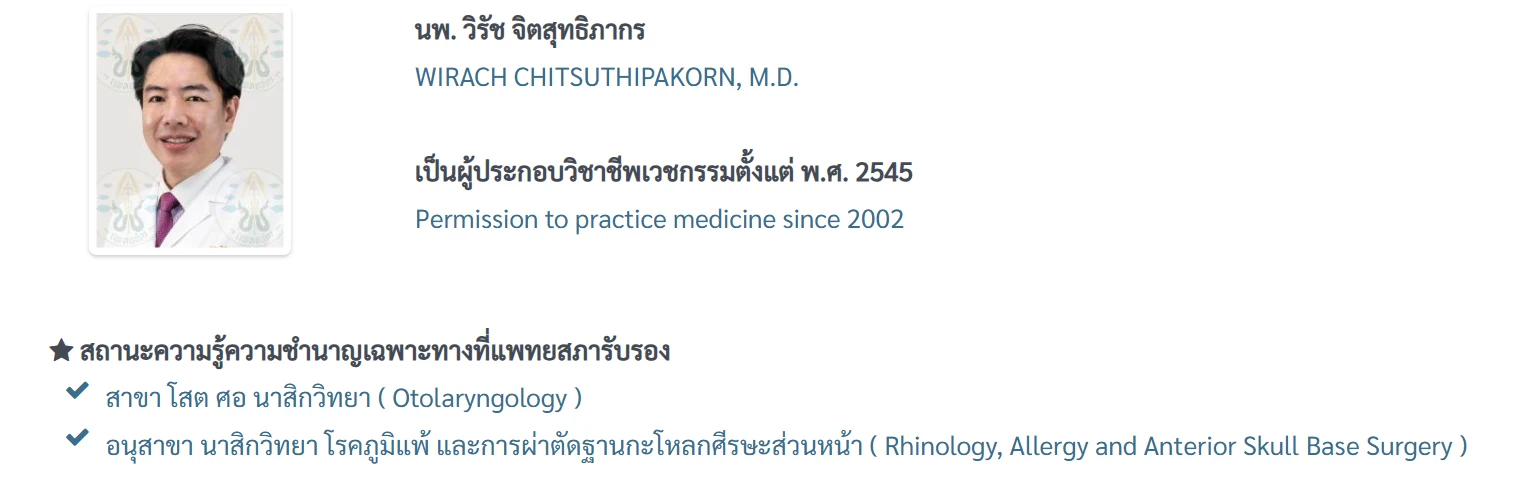
Screenshot from the Medical Council of Thailand website (29 November 2026): licensed to practise medicine since 2002; recognised in Otolaryngology and in the subspecialty of Rhinology, Allergy and Anterior Skull Base Surgery.