
Why is a second opinion important in medicine?
อ่านภาษาไทย →A second opinion means asking another doctor to review the same test results and give an independent view. It is a patient right under Thailand's 2015 Declaration of Patient Rights and Responsibilities, not a sign of distrust in your doctor. A second opinion can confirm or refine a diagnosis and help you decide with more confidence, especially before major surgery, before revision surgery, or when treatment has not helped. Bring the CT images as files, any operative notes and any biopsy results.
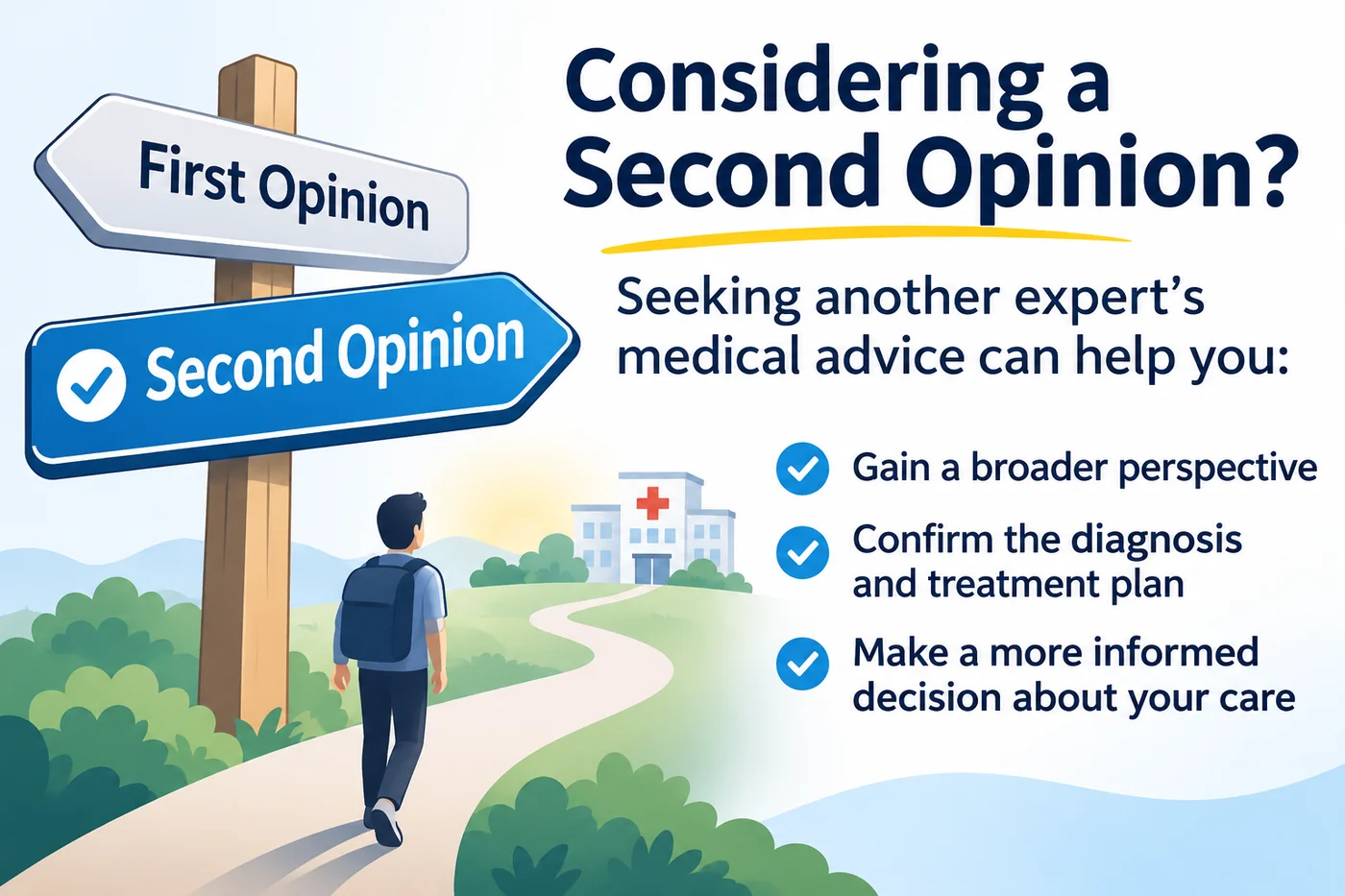
A second opinion means asking another doctor to review the same test results and give an independent view on whether the diagnosis and treatment plan are right. Asking for a second opinion is not a sign of distrust in your doctor; it is a patient right. Thailand's 2015 Declaration of Patient Rights and Responsibilities, issued jointly by the Medical Council of Thailand and the other health professional councils, states that patients have the right to ask for the opinion of a health professional who is not treating them, and the right to change their provider.[1]
What can a second opinion do?
Medicine always involves some uncertainty. The same symptoms can have several causes, and the same disease can often be treated in more than one way. A study from Mayo Clinic in the United States looked at 286 patients referred by primary care clinicians for a specialist assessment. The final diagnosis was the same in 12%, better defined or refined in 66%, and clearly different in 21%.[2] The study was done at a single hospital, so these numbers do not apply everywhere, but it shows that another doctor's review can genuinely confirm, refine or change a diagnosis.
Even when the second opinion agrees with the first, it is still useful, because you can make your treatment decision with more confidence.
When should I ask for a second opinion?
- Before major surgery, or any treatment that cannot be undone
- After sinus surgery that did not help, or when a doctor recommends revision surgery
- When the diagnosis is still unclear, or test results do not match the symptoms
- When a mass or tumour is found in the nose or sinuses
- When symptoms have not improved after a long time on treatment
- When doctors have given you conflicting advice, or you still do not feel sure
If you have emergency symptoms, such as a swollen eye, double vision, a severe headache or a nosebleed that will not stop, go to hospital straight away. Do not wait for a second opinion.
What should I bring?
- CT or MRI images as image files (a CD or DICOM files), not only the written report
- The operative note, if you have had surgery
- Biopsy results, if any
- A list of the medicines you take now and have taken before
- A timeline of your symptoms, from when they started until now
Patients have the right to see the treatment information in their own medical record, by making a request through the hospital's procedure.[1]
Should I tell the doctor who is treating me?
Yes. Most doctors are happy for patients to ask for a second opinion, and being open about it helps you get complete records. For my own patients: if you would like a second opinion from another doctor, I am happy for you to do so, and I will prepare all the information you need. If the two doctors' opinions differ, ask each of them to explain their reasons and talk it through again. In some cases a third opinion may be needed.
How can I get a second opinion from me?
I review cases to give second opinions. Send your history, test results and CT images through Send a message for a second opinion, or book an appointment at the hospital. Read more about revision surgery in Dealing with difficult sinus cases.
References
- The Medical Council of Thailand, Thailand Nursing and Midwifery Council, Pharmacy Council, Dental Council, Physical Therapy Council, Medical Technology Council and the Committee on the Practice of the Art of Healing. Declaration of Patient Rights and Responsibilities (in Thai). 12 August 2015. https://www.tmc.or.th/file_download/declaration.pdf
- Van Such M, Lohr R, Beckman T, Naessens JM. Extent of diagnostic agreement among medical referrals. J Eval Clin Pract. 2017;23(4):870-874. doi:10.1111/jep.12747