
Nasopharyngeal cancer: what it is, symptoms, tests and treatment
อ่านภาษาไทย →Nasopharyngeal carcinoma starts in the space at the very back of the nose, above the uvula. It is common in East and Southeast Asia and is closely linked to the Epstein-Barr virus (EBV). Warning signs are a painless neck lump, a blocked ear on one side in an adult, and blood-stained nasal mucus or phlegm. Diagnosis needs an endoscopy and a biopsy. The main treatment is radiotherapy, with chemotherapy added for more advanced disease. Found early, the chance of cure is high.
Nasopharyngeal carcinoma (NPC) is a cancer of the nasopharynx, the space at the very back of the nose, above the uvula and soft palate. You cannot see this area with the naked eye, so early symptoms are often vague and look like common problems such as a blocked ear, a stuffy nose or a swollen gland. As a result, many people only see a doctor once the disease is already advanced.
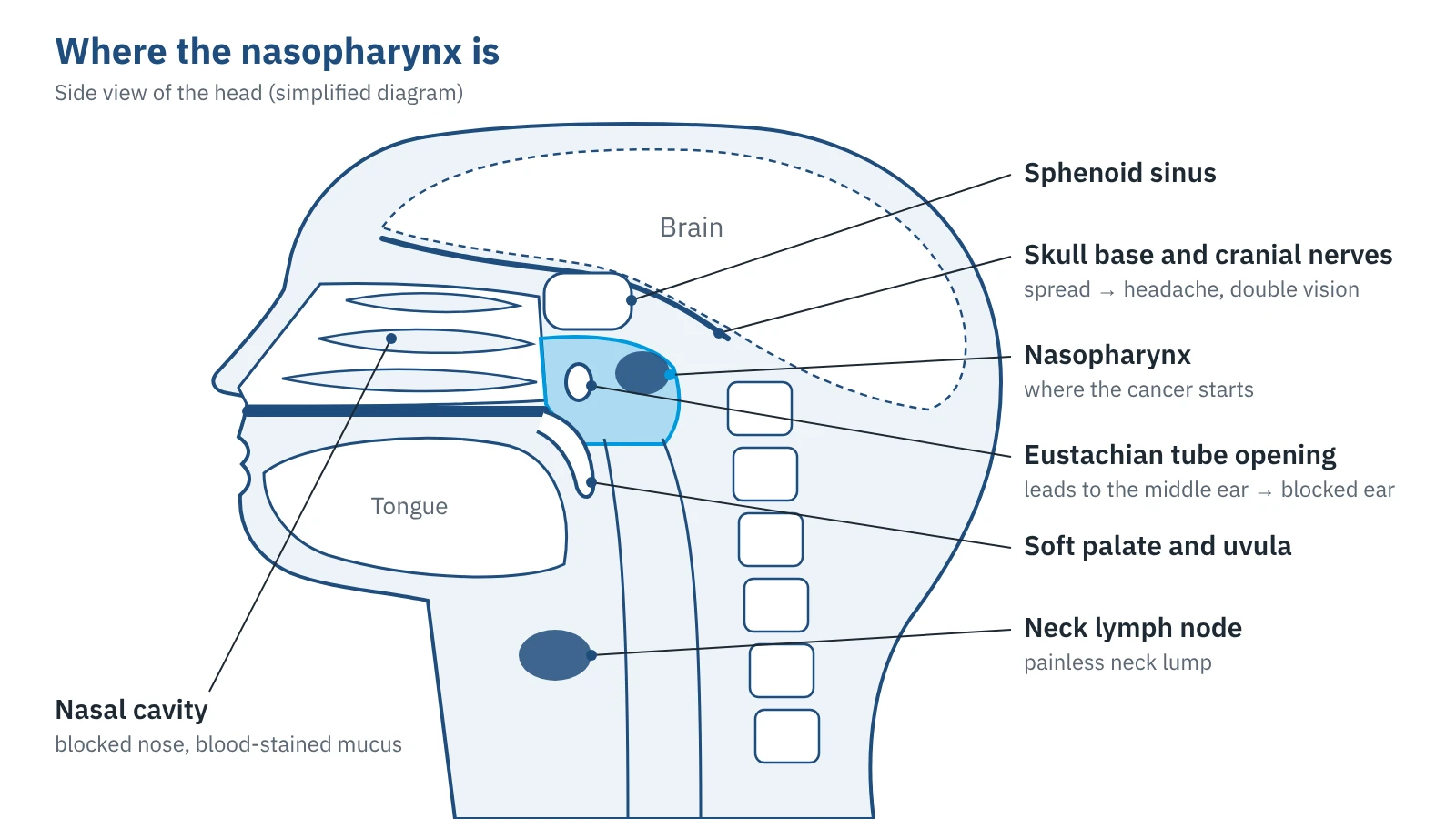
The good news is that this cancer responds well to radiotherapy, and treatment has improved a great deal over the past ten years or so. Found at an early stage, the chance of cure is very high.[1] In this article I explain what the disease is, who is at risk, which symptoms need prompt checking, and how it is treated.
How common is nasopharyngeal cancer, and who is at risk?
Nasopharyngeal cancer is uncommon in Western countries but particularly common in East and Southeast Asia, especially southern China.[1] That is why people in Thailand should know about it. The main risk factors are:
- Epstein-Barr virus (EBV): the type of nasopharyngeal cancer common in Asia is closely linked to this virus. But most people catch EBV in childhood and never get cancer, so having the virus does not mean you will get the disease.
- Genetics and family history: if a close relative has had this cancer, your risk is higher than average.
- Diet: eating salted fish and salty preserved foods regularly, especially from childhood.
- Smoking: smoking increases the risk.
The disease is more common in men than in women, and it can start in working-age adults, not only in older people.[1]
Which symptoms should make you think of nasopharyngeal cancer?
Symptoms depend on which way the tumour grows. To make them easy to remember, I group them into four:
- Neck lump: the most common symptom. It is usually a firm, painless lump on the side of the neck below the earlobe that slowly grows and does not go down after anti-inflammatory medicine. The lump is a lymph node that the cancer has spread to.
- Ear symptoms: a blocked or dull ear, or fluid in the middle ear on one side, because the tumour blocks the tube that balances ear pressure (the Eustachian tube). Every adult with fluid in one ear without a preceding cold should have the back of the nose checked with an endoscope.
- Nose symptoms: a blocked nose, nasal mucus or phlegm sniffed back from the throat with a little blood in it, especially in the morning, or nosebleeds.
- Nerve symptoms: once the tumour reaches the skull base, there may be severe headache, double vision, facial numbness or trouble swallowing.
Many of these symptoms also occur in everyday conditions such as colds, sinusitis or allergies. What should raise suspicion is a symptom that is on one side, lasts more than 2–3 weeks, or does not get better with usual treatment. If that is the case, see an ear, nose and throat (ENT) doctor.
How do doctors make the diagnosis?
- Endoscopy of the nasopharynx: the ENT doctor passes a thin endoscope through the nostril. It takes a few minutes and is done in the clinic with a local anaesthetic spray, and it shows any lump or abnormal tissue clearly.
- Biopsy: a cancer diagnosis must always be confirmed by a tissue sample. Most biopsies can be taken through the endoscope in the clinic.
- Imaging to find the stage: magnetic resonance imaging (MRI) shows how far the tumour extends, including the skull base, and further tests such as positron emission tomography with computed tomography (PET-CT) look for spread to other organs when appropriate.[2]
- EBV DNA blood test: helps assess how extensive the disease is and is used to monitor results after treatment.[1][2]
If you find a lump in your neck, do not rush to have the neck lump removed before the back of your nose has been examined with an endoscope. If it turns out to be nasopharyngeal cancer, the main treatment is radiotherapy, so removing the neck lump first does not help and can make treatment more complicated.
Can you be screened?
A large study in Hong Kong tested EBV DNA in the blood of 20,174 men without symptoms. Those who tested positive twice had an endoscopy and an MRI. The study found 34 nasopharyngeal cancers, most of them at an early stage (71%, compared with 20% in an earlier group of patients who came to the doctor on their own). The test had a sensitivity of 97.1% and a specificity of 98.6%.[3]
However, this study was done in an area where the disease is very common, and there is no recommendation yet to screen everyone in Thailand. If a close relative has had this cancer, or you are worried, you can ask an ENT doctor for an endoscopic check.
How is it treated?
Treatment depends on the stage of the disease and is planned as a team by the ENT doctor, the radiation oncologist and the medical oncologist.[2]
- Radiotherapy: the main treatment for nasopharyngeal cancer. The tumour sits deep against the skull base, so removing it completely with surgery is difficult. Intensity-modulated radiotherapy (IMRT) aims the radiation at the tumour more precisely and reduces side effects on the surrounding organs.[1]
- Chemotherapy: the earliest stage is usually treated with radiotherapy alone. More advanced stages get chemotherapy together with radiotherapy, and some patients get chemotherapy before radiotherapy starts.[2]
- Immunotherapy: has a role when the disease comes back or spreads to other organs.[1]
- Surgery: not the first treatment, but it has a role when disease remains or comes back in one place, for example surgery on the neck lymph nodes, or endoscopic surgery on the nasopharynx through the nostrils in suitable patients.[2]
During and after radiotherapy there may be side effects such as a dry mouth, sore throat, difficulty swallowing, darkened red skin on the neck, a blocked ear, or thick mucus and crusts in the nose. Many of these slowly improve after treatment ends. Rinsing the nose with saline helps reduce crusts and smell; see how in the article on saline nasal irrigation.
How should you look after yourself after treatment?
You need regular follow-up visits, especially in the first 2–3 years, when the disease most often comes back. The doctor will do an endoscopy, examine your neck, and may order an MRI or an EBV DNA test when appropriate.[2] Stop smoking, and look after your mouth and teeth with a dentist, because radiotherapy reduces saliva and makes tooth decay more likely. Have your hearing and thyroid function checked from time to time.
When should you see a doctor promptly?
See an ENT doctor if you have any of the following:
- A painless lump in the neck that does not go down within 2–3 weeks
- A blocked ear or fluid in one ear as an adult, especially without a preceding cold
- Repeated blood-stained nasal mucus or phlegm, or a nose blocked on one side that does not clear; read more in one nostril always blocked
- An unusually severe headache, double vision or facial numbness
An endoscopy of the back of the nose takes only a few minutes and gives you an answer quickly. If nothing is found, you can stop worrying; if the disease is found early, the chance of cure is high. If you have already been diagnosed and would like a second opinion before starting treatment, you can ask for one too.
References
- Chen YP, Chan ATC, Le QT, Blanchard P, Sun Y, Ma J. Nasopharyngeal carcinoma. Lancet. 2019;394(10192):64-80. doi:10.1016/S0140-6736(19)30956-0
- Bossi P, Chan AT, Licitra L, et al. Nasopharyngeal carcinoma: ESMO-EURACAN Clinical Practice Guidelines for diagnosis, treatment and follow-up. Ann Oncol. 2021;32(4):452-465. doi:10.1016/j.annonc.2020.12.007
- Chan KCA, Woo JKS, King A, et al. Analysis of plasma Epstein-Barr virus DNA to screen for nasopharyngeal cancer. N Engl J Med. 2017;377(6):513-522. doi:10.1056/NEJMoa1701717